|

|

|
You’ll find our blog to be a wealth of information, covering everything from local market statistics and home values to community happenings. That’s because we care about the community and want to help you find your place in it. Please reach out if you have any questions at all. We’d love to talk with you!
|
|
|
 1. Surprise Love Notes
Grab a package of heart-shaped Post-it notes from the grocery store, write down things you love about him or her and scatter them throughout the house. They will love it!
If you like to bake, this is a fun, frugal Valentine’s Day gift idea. If Valentine’s Day falls on a week day, surprise him or her at work by dropping off a plate of their favorite goodies and a note. They’ll surely be the envy of co-workers! Bonus points for making them heart-shaped!
One of my favorite Valentine’s Day gift ideas for him is to put together a big card (made with poster board or foam core board) with candy bars attached and cute candy bar sayings. These are so much fun to do! The only hard part is resisting the urge to eat the candy!
Looking for out of the box Valentine’s Day gift ideas? Look no further than a bespoke Pinterest board! Fill it with images, videos, and websites that speak to your significant other’s interests or that will make them smile.

This is a quick Valentine’s Day gift bouquet I made for my husband last year. I was definitely in a “last minute” situation, but luckily I tend to thrive under pressure. :-) He loved it!
Plan ahead to have the kids stay with Grandma or another relative overnight on Valentine’s Day (or around then — it doesn’t hurt to be flexible!) This will give you both some “alone time” to focus on each other, and to sleep in!
Wake up extra early and start Valentine’s Day off special with a batch of heart-shaped pancakes! Just pour the batter in the frying pan in a free-form heart shape and serve with strawberries and whipped cream. This would definitely show your loved one how much you care.
Valentine’s Day is a celebration of love, so consider branching out from romance into charity and friendship. Volunteer at a soup kitchen, send flowers to nursing home residents, or contact a local women’s shelters to ask how you can best show love to those who live and work there. Little things can make all the difference for people who are in need of a little extra love.
Getting the garden ready for spring is something home gardeners look forward to all winter long. The days are getting longer, the weather is getting warmer, and it's almost time for a new season to begin.
But there's more to preparing your garden for planting than paging through seed catalogs and daydreaming about juicy homegrown tomatoes. You'll want to take stock of your gear and supplies, make a plan, and get everything ready for a successful growing season.
Here's a step-by-step guide to getting your garden ready for spring
The first step in getting your garden ready for spring begins in mid-to-late winter with pruning. Plan to prune fruit trees six to 12 weeks before your hardiness zone's last frost date, ideally after the coldest temperatures have passed but before buds have formed.
Some shrubs can also be pruned around this time, as can many types of roses. Use sharp, sterilized shears, loppers, or a saw to cut away any dead or damaged growth, remove crossing branches, and shape the plant. However, spring-blooming shrubs, like azaleas, should be pruned after flowering in the spring to avoid removing flower buds. Likewise, hydrangea pruning depends upon the type of hydrangea growing in your garden. Some hydrangeas bloom on old wood, and pruning too early can mean a summer without flowers. Always check your shrubs' pruning recommendations prior to cutting them back.
Before the growing season gets into full swing, it's a good idea to inspect the tools and equipment you'll need in the garden.
It's easy to get excited about buying new seeds as you prepare for the growing season, but it's important to inventory any seeds, bulbs, or other propagation material you may have saved from previous seasons. Many seeds remain viable for years, so you can save money by using the seeds you already own.
Take the time to organize your stash, take an inventory on paper, and cull any seeds you're not interested in growing this year. You can donate them, share them with friends, or swap them with fellow gardeners.
This is the time gardeners look forward to all winter: sitting down with your seed inventory, a stack of seed catalogs, and a notebook to dream up the new season's planting plan. You'll want to take your USDA hardiness zone, your space constraints, sun exposure, and soil type into account, as well as the growth habit and needs of each particular plant.
One tip is to site tall plants to the north of shorter ones so they won't block the sunlight. It's a good idea to plant spring crops together so you can harvest them and then plant summer veggies in their place.
Once you've made your garden plan, it's time to order seeds. You can buy seeds at local plant shops, nurseries, and garden centers if you prefer to shop in person. An added benefit of sourcing seeds locally is that shops will typically stock varieties that do well in your growing zone.
You can order from seed companies and even buy plant starts online, although you'll want to wait until the weather is warm enough to have any live plants shipped. Another option is to check out local farmers' markets and farmstands, which may take pre-orders for spring and summer vegetable starts.
A few weeks before planting time, you'll want to prep garden beds and containers. Rake off any mulch you may have used to cover the soil for winter, like straw or shredded leaves. Pull any early weeds that may have sprung up.
While tilling or turning over the soil with a fork or shovel was long considered necessary to work in fertilizer, gardening experts now recommend a no-till approach. Instead, add organic compost to the soil surface in raised beds and in-ground beds. Refresh pots and planters with fresh potting mix or top-dress them, spreading a thin layer of compost over the soil.
Indoor seed starting is one of the best ways to save money when planting your garden. Check seed catalogs and packets for when to start seeds indoors versus direct-sowing them in your garden. Depending on your hardiness zone and the variety, you may need to start seeds in late winter or very early spring—anywhere from six to 12 weeks before your zone's last frost date. Some seeds may need special treatment to germinate well, such as stratification—a cold period—so include the amount of time needed in your planning.
Check the "days to maturity" number, which will help you figure out when those plants should be ready to harvest based on the date you plant. Also, make sure to add extra time to harden off seedlings before you plant them in the garden.
If you live in an area that's prone to cold winters, consider taking the extra step of removing your window screens before the chilly season begins. While window screens are great in the summer for preventing debris and insects from sneaking in your open windows, there's no need for them in winter when windows stay closed. The benefits from this small task can positively impact your mood, the lifespan of your windows, and even your pocketbook.
Harsh winter weather can be extremely hard on windows, especially screens. According to Harvey Windows, high winds and heavy snow can cause ripping and warping to screens. The cold and wet conditions can also easily bow the screens, making them appear loose in the windowsill. Save your existing screens by being proactive with this preventive measure.
Window screens act as a trap during winter, locking in moisture from the snow and ice that's landed inside the windowsill until it melts. This excess water can cause moisture damage to the windowsill, window, and screen. The moisture can also lead to mold and mildew in the windowsill come spring.
If winter gives you the seasonal blues, removing your window screens is a great way to let in more natural light. While sunlight is limited in winter months, soaking in as much of it as possible could help boost your mood. Your space will also feel warmer and cozier because of this small change.
ANNE SCHLECHTER
One of the biggest reasons to remove window screens is to increase your home's energy efficiency by letting in more solar heat. This increase in passive sunlight will result in your heating system having to work less, potentially giving you a lower heat bill in return. According to Allstar Construction of Fargo, the space near windows that do not have window screens is about 8 degrees warmer on a sunny winter day.
Before putting your window screens into storage or reinstalling them, clean them by vacuuming debris off both sides and washing them gently with a soapy rag. Rinse them with water and let them dry completely. You can dry them with a towel before air drying. To make reinstallation easier, use masking tape and a marker to signify which screen goes in which window.
Once the cold of winter passes and it's time to do a spring deep clean, you'll also find it much easier to clean your windows and windowsills now that the screens are already removed. Be sure to get into all of the grooves and rails of the windowsill to remove built-up dirt and grime before reinstalling the screens. You can do this task by first using a vacuum with a hose attachment, then wiping them down with soapy water.
As you think about the year ahead, one of your big goals may be moving. But, how do you know when to make your move? While spring is usually the peak homebuying season, you don’t actually need to wait until spring to sell. Here's why.
Last October, the 30-year fixed mortgage rates peaked at 7.79%. In January, they hit their lowest level since May. That means you may not feel as locked-in to your current mortgage rate right now. That downward trend in rates has made moving more affordable now than it was just a few months ago.
Another reason today’s rates make now a good time to sell? More buyers are jumping back into the market. Many had been waiting on the sidelines for rates to fall, but now that that’s happening, they’re eager and ready to buy. That means more demand for your house. According to Sam Khater, Chief Economist at Freddie Mac:
“Given this stabilization in rates, potential homebuyers with affordability concerns have jumped off the fence back into the market.”
Right now, there are still more people looking to buy a home than there are houses for sale, which puts you in a great position. But keep in mind, with the recent uptick in new listings, we’re seeing more sellers may already be re-entering the market.
Listing your house now helps you beat your competition and makes sure your house will stand out. And if you work with an agent to price it right, it could sell fast and get multiple offers. U.S. News explains:
“When there is low housing inventory, sellers could get top dollar for their homes.”
Experts forecast home prices will keep going up this year. What does that mean for you? If you're ready to sell your current house and plan to buy another one, it may be a good idea to think about moving now before prices go up more. That would give you the chance to buy your next home before it gets more expensive.
Homeowners today have tremendous amounts of equity. In fact, a recent report from CoreLogic says the average homeowner with a mortgage has more than $300,000 in equity.
If you've been waiting to sell because you were worried about home affordability, know your equity can really help with your next move. It might even cover a big part, or maybe all, of the down payment for your next home.
If you're thinking about selling your house and moving to another one, let’s connect to get the process started now so you can get a leg up on your competition.
On the road to becoming a homeowner? If so, you may have heard the term pre-approval get tossed around. Let’s break down what it is and why it’s important if you’re looking to buy a home in 2024.
As part of the homebuying process, your lender will look at your finances to figure out what they’re willing to loan you. According to Investopedia, this includes things like your W-2, tax returns, credit score, bank statements, and more.
From there, they’ll give you a pre-approval letter to help you understand how much money you can borrow. Freddie Mac explains it like this:
“A pre-approval is an indication from your lender that they are willing to lend you a certain amount of money to buy your future home. . . . Keep in mind that the loan amount in the pre-approval letter is the lender’s maximum offer. Ultimately, you should only borrow an amount you are comfortable repaying.”
Now, that last piece is especially important. While home affordability is getting better, it’s still tight. So, getting a good idea of what you can borrow can help you really wrap your head around the financial side of things. It doesn’t mean you should borrow the full amount. It just tells you what you can borrow from that lender.
This sets you up to make an informed decision about your numbers. That way you’re able to tailor your home search to what you’re actually comfortable with budget-wise and can act fast when you find a home you love.
If you want to buy a home this year, there’s another reason you’re going to want to be sure you’re working with a trusted lender to make this a priority.
While more homes are being listed for sale, the overall number of available homes is still below the norm. At the same time, the recent downward trend in mortgage rates compared to last year is bringing more buyers back into the market. That imbalance of more demand than supply creates a bit of a tug-of-war for you.
It means you’ll likely find you have more competition from other buyers as more and more people who were sitting on the sidelines when mortgage rates were higher decide to jump back in. But pre-approval can help with that too.
Pre-approval shows sellers you mean business because you’ve already undergone a credit and financial check. As Greg McBride, Chief Financial Analyst at Bankrate, says:
“Preapproval carries more weight because it means lenders have actually done more than a cursory review of your credit and your finances, but have instead reviewed your pay stubs, tax returns and bank statements. A preapproval means you’ve cleared the hurdles necessary to be approved for a mortgage up to a certain dollar amount.”
Sellers love that because that makes it more likely the sale will move forward without unexpected delays or issues. And if you may be competing with another buyer to land your dream home, why wouldn’t you do this to help stack the deck in your favor?
If you’re looking to buy a home in 2024, know that getting pre-approved is going to be a key piece of the puzzle. With lower mortgage rates bringing more buyers back into the market, this can help you make a strong offer that stands out from the crowd.

Finding the right home is one of the biggest challenges for potential buyers today. Right now, the supply of homes for sale is still low. But there is a bright spot. Newly built homes make up a larger percent of the total homes available for sale than normal. That’s why, if you’re craving more options, it makes sense to see if a newly built home is right for you.
But it’s important to remember the process of working with a builder is different than buying from a homeowner. And, while builders typically have sales agents on-site, having your own agent helps make sure you have proper representation throughout your homebuying journey. As Realtor.com says:
“Keep in mind that the on-site agent you meet at a new-construction office works for the builder. So, as the homebuyer, it’s a smart idea to bring in your own agent, as well, to help you negotiate and stay protected in the transaction.”
Here’s how having your own agent is key when you build or buy a new construction home.
It’s important to consider how the neighborhood and surrounding area may evolve before making your home purchase. Your agent is well-versed in the upcoming communities and developments that could influence your decision. One way a real estate agent can help is by reviewing the builder's site plan. For example, you’ll want to know if there are any plans to construct a highway or add a drainage ditch behind your prospective backyard.
An agent also has expertise in the construction quality and reputation of different builders. They can give you insights into each one's track record, customer satisfaction, and construction practices. Armed with this information, you can choose a builder known for consistently delivering top-notch homes.
The most obvious benefit of opting for new home construction is the opportunity to customize your home. Your agent will guide you through that process and share advice on the upgrades that are most likely to add long-term value to your home. Their expertise helps make sure you focus your budget on areas that will give you the greatest return on your investment later.
When it comes to working with builders, having a skilled negotiator on your side can make all the difference. Builder contracts can be complex. Your agent can help you navigate these contracts to make sure you fully understand the terms and conditions. Plus, agents are skilled negotiators who can advocate for you, potentially securing better deals, upgrades, or incentives throughout the process. As Realtor.com says:
“A good buyer’s agent will be able to review any contracts before you sign on the dotted line, ensuring you aren’t unwittingly agreeing to terms that only benefit the builder.”
If you are interested in buying or building a new construction home, having a trusted agent by your side can make a big difference. If you'd like to start that conversation, let’s connect.
Have you been thinking about selling your house? If so, here’s some good news. While the housing market isn't as frenzied as it was during the ‘unicorn’ years when houses were selling quicker than ever, they’re still selling faster than normal.
The graph below uses data from Realtor.com to tell the story of median days on the market for every January from 2017 all the way through the latest numbers available. For Realtor.com, days on the market means from the time a house is listed for sale until its closing date or the date it’s taken off the market. This metric can help give you an idea of just how quickly homes are selling compared to more normal years:
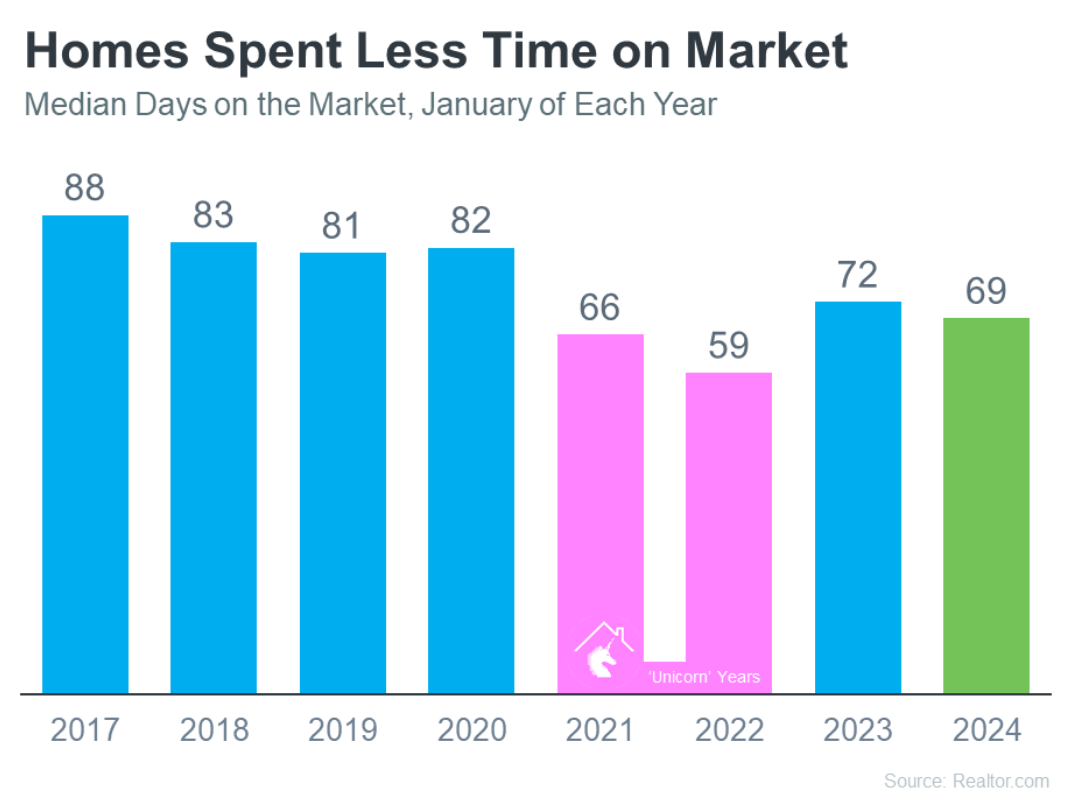
When you look at the most recent data (shown in green), it's clear homes are selling faster than they usually would (shown in blue). In fact, the only years when houses sold even faster than they are right now were the abnormal ‘unicorn’ years (shown in pink). According to Realtor.com:
“Homes spent 69 days on the market, which is three days shorter than last year and more than two weeks shorter than before the COVID-19 pandemic.”
Homes are selling faster than the norm for this time of year – and your house may sell quickly too. That’s because more people are looking to buy now that mortgage rates have come down, but there still aren’t enough homes to go around. Mike Simonsen, Founder of Altos Research, says:
“. . . 2024 is starting stronger than last year. And demand is increasing each week.”
If you’re wondering if it’s a good time to sell your home, the most recent data suggests it is. The housing market appears to be stronger than it usually is at this time of year. To get the latest updates on what’s happening in our local market, let’s connect.
Despite a wide variety of countertop materials to choose from, soapstone stands out as a preferred choice. This guide to soapstone countertops offers the best design ideas, pros and cons of the natural stone material, plus cleaning and maintenance guidance.
Soapstone is a natural stone material composed of talc, chlorite, and dolomite. Its beautiful aesthetic has been popular for centuries, commonly used in carvings, statues, bowls, and fireplaces. In recent years, soapstone has gained popularity as a material for sinks, tiles, and countertops, too.
Talc gives the material its smooth and soapy texture, hence the name "soapstone," and it comes in shades of gray, blue, and black. Soapstone countertops are known for their resistance to stains, heat, and acid. And thanks to its nonporous nature and antimicrobial properties, it doesn't need to be sealed like other stone countertop materials, such as marble or granite.
Soapstone's durability, and unique appearance rank it among homeowners’ top countertop choices. However, soapstone does require protection and maintenance, as it is prone to scratches, nicks, and chipping.
There are different types of soapstone available, each with its own distinct characteristics. The most common types include:
There are several advantages to having a soapstone countertop. Here are some of the top selling points of soapstone.
If you use your countertops for cooking, serving meals, or storage, soapstone is a good choice. It is highly durable and can withstand daily wear and tear.
Kitchens that see heavy traffic, especially clumsy cooks or messy kids, will benefit from the stain resistance of soapstone. While soapstone countertops aren't completely impervious to stains, they are less prone to staining compared to marble or granite.
No trivet? No problem. Soapstone is known for its excellent heat resistance, making it ideal for placing hot pots or pans directly on the countertop surface.
A soapstone countertop is a thing of beauty that will elevate the look and feel of any room. With its natural, subtle veining and varying shades of gray, it can provide a timeless and elegant focal point for any kitchen or bathroom.
The softness of soapstone makes it easy for homeowners to add design features or practical elements that can be built right into the countertop. Dish drainage grooves or soap holder basins are prime examples of what’s possible.
Despite having many advantages, soapstone countertops also have a few drawbacks to consider.
Soapstone is generally a durable material but it can develop scratches and dents over time. However, these can be easily sanded or blended naturally with the patina to create an intentionally weathered look.
Soapstone is primarily available in grays, greens, blues, black, or white. This color palette might not suit everyone's design preferences or match all decor styles.
To enhance its natural luster and protect from stains, soapstone countertops require periodic maintenance, including oiling.
Stone countertops are expensive. The cost of soapstone countertops varies depending on factors such as the type and quality of the chosen soapstone, the thickness of the stone (the average ranges from 1.25 inches for kitchen countertops to 2 inches for bathroom countertops), the size of the countertop, the complexity of the installation, and local materials and installation prices.
On average, soapstone countertops range from $55 to $120 per square foot, with installation costs at around $90 per square foot. The total cost of materials and installation for a 50-square-foot countertop costs approximately between $2,500 and $5,000.
While soapstone is commonly associated with shades of gray and can appear to be a solid color in photos, veining and streaks are common in the slabs. Some popular soapstone color options include classic dark gray in rich, deep tones. Light gray offers a more contemporary, airy look. Soapstone in shades of green and blue add a unique touch to any kitchen.
Black or white options are also available to add a sophisticated contrast to wood accents. Due to the rarity of the stone, these more unique color combinations may come at a higher price tag.
While many home improvement projects can be DIY, stone countertops should be professionally installed. Soapstone’s heavy weight needs to be supported by solid, reinforced kitchen furniture, so professional installation is required. Correct placement and fit are very important.
Sealing soapstone countertops, though not required, can enhance the stone’s stain-resistant properties.
To keep your soapstone countertops looking like new, plan for proper cleaning and maintenance. Clean them daily by wiping the surface with a mild soap and water solution using a soft cloth or sponge. Mild bleach solutions can also be used.
Countertops should also be oiled after installation and then again monthly. Use food-grade mineral oil to enhance the natural beauty of soapstone and protect it from stains. If a stain occurs, make a poultice using a mixture of baking soda and water, apply it to the stain, and let it sit overnight before rinsing. It may take several applications before the stain lifts.
When choosing countertop materials for a kitchen or bathroom, many homeowners prefer the look and durability of stone over laminate, tile, or wood. Stone countertops are available in a wide array of unique colors and patterns, and deciding between quartz vs. granite means choosing from two of the most popular materials. Continually a top choice for countertops, granite is a natural stone mined from quarries, cut into slabs, and polished before installation. Although quartz also occurs naturally, it's considered an engineered stone because the surface is manufactured using crushed quartz crystals combined with pigments and resin for binding. The composite material replicates the look of natural stone and is growing in popularity as a countertop material.
Both quartz and granite offer beautiful texture and long-lasting durability for kitchen and bathroom surfaces. If you're unsure which is best for you, use this simple quartz vs. granite guide to help inform your decision. We compare the differences between quartz and granite in price, appearance, durability, and maintenance to choose the right countertop material for your space and lifestyle.
As with any material, the visual differences between quartz vs. granite are a matter of taste. Some people prefer the natural and unique look of granite countertops. Granite countertop colors are typically grouped into ten basic categories: beige, black, blue, brown, burgundy, gray, green, red, yellow, and white. The most popular choice is black, though lighter shades of granite can open up a kitchen. The least common granite colors are red, blue, and green.
Others like the wider variety of patterns and colors offered by quartz countertops. Because it's manmade, quartz countertops are available in patterns that provide the look of high-end marble at a lower price.
Stone countertops are popular in kitchens for a reason. Granite is often cited as the most durable natural countertop material and is known for resisting cracks and chips. However, as a manufactured material, quartz vs. granite rates slightly higher on the hardness scale and is somewhat more damage-resistant.
You can clean both materials with mild soap and water. Gentle cleaners are also suitable for quartz countertops, but some all-purpose cleaners might be too harsh for granite. Plan to use a cleaner designed for granite ($7, Target) to protect the surface. It's best to wipe up spills as soon as they happen to prevent stains from forming. Quartz countertops are highly resistant to stains, but if they happen, you can typically remove them with glass cleaner and a non-abrasive sponge. Remove granite marks and spots using a granite stain remover ($8, The Home Depot) that will lift the stain from the surface without scrubbing
Because granite is a porous material, it must be resealed yearly. With a proper seal, granite countertops are very resistant to stains. Minor scratches or dings in granite can be filled in with color-matching epoxy or resin from the home improvement store, but professional installers should repair cracks larger than an ice cube.
Quartz countertops are nonporous, which allows the surface to repel coffee, oil, and even food coloring without sealing. Damaged quartz is trickier to repair and should always be done by a professional, which could increase quartz countertops' overall cost.
A professional should install granite and quartz countertops, which are extremely heavy and difficult to handle. Additionally, cutting holes for the sink is no easy task. Granite and quartz countertops are priced similarly per square foot, each with a price range starting at about $80. High-quality quartz countertops might cost up to $140 per square foot, while granite can cost up to $175 or more. The price depends on the stone's color, pattern, and surface treatments. In either case, slab remnants can save big money if your countertop is small enough
:strip_icc():format(webp)/2088_BHG_Llewellyn_0079-d61ee26c98a54c45bbc48814e8c97352.jpg)