


March 13, 2025
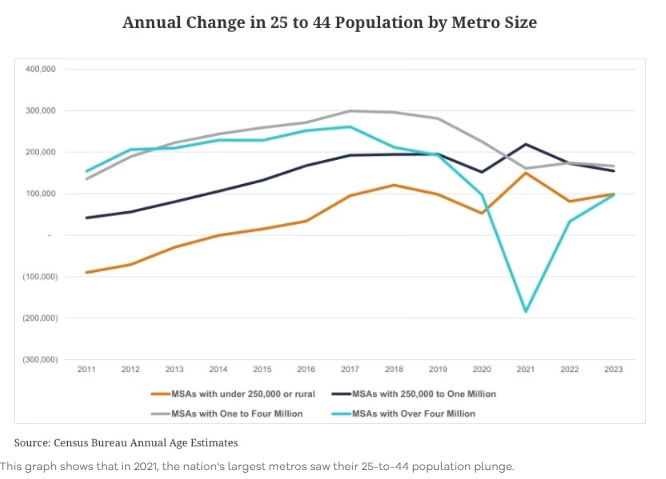
Young adults have been flocking to small towns and rural areas at the most dramatic pace in decades—and it's a trend that's not letting up anytime soon.
Since the COVID-19 pandemic, internal migration took an unexpected turn with large numbers of younger adults aged 25 to 44 flocking to these areas. And as a result, they've been fueling a small-town revival, according to Hamilton Lombard, estimates program manager of the Demographics Research Group at the University of Virginia's Weldon Cooper Center for Public Research.
The 2023 county population estimates released by the U.S. Census Bureau in spring 2024 showed that since 2020, two-thirds of growth in the population occurred in areas with fewer than 1 million residents, or in rural counties.
And despite many companies mandating a return to the office, the migration of younger adults into these areas accelerated in 2023.
"Perhaps the most striking statistic within the 2023 age estimates is the fact that since 2020, the country’s small towns and rural areas have been attracting younger adults at the highest rate in nearly a century," writes Lombard.
This is in stark contrast to the past decade, where 90% of this growth was concentrated in the largest metro areas with more than 4 million residents.
Starting in the late 1970s, young adults pursuing well-paying jobs in white-collar industries started fleeing areas with populations of fewer than 250,000 people in favor of places like New York City, San Francisco, and Washington, DC.
By the 1990s, this large-scale exodus caused a change in the population, where many of these areas failed to gain new residents younger than 45. That continued into the 2010s when migration into larger metros reached its highest point in more than a half-century.
"The migration of young adults from rural to urban areas caused communities to become increasingly unbalanced demographically," writes Lombard.
For example, Arlington County, VA, across the Potomac River from Washington, DC, which saw its population of young adults grow faster than in any other county within the nation's 20 largest metros, had six times as many younger residents as those over age 65.
Meanwhile, in the more rural Highland County, VA, along Virginia’s western border, the over-65 population was twice the size of residents aged 25 to 44.
As the 2010s rolled on, Lombard writes that all the census and economic data were pointing to the age divide between rural and urban areas growing ever wider.
But in 2020, just as the U.S., along with the rest of the world, was walloped by the first wave of the COVID-19 pandemic, the demographic trajectory made an unexpected U-turn.